Reverse Logistics & Backhaul
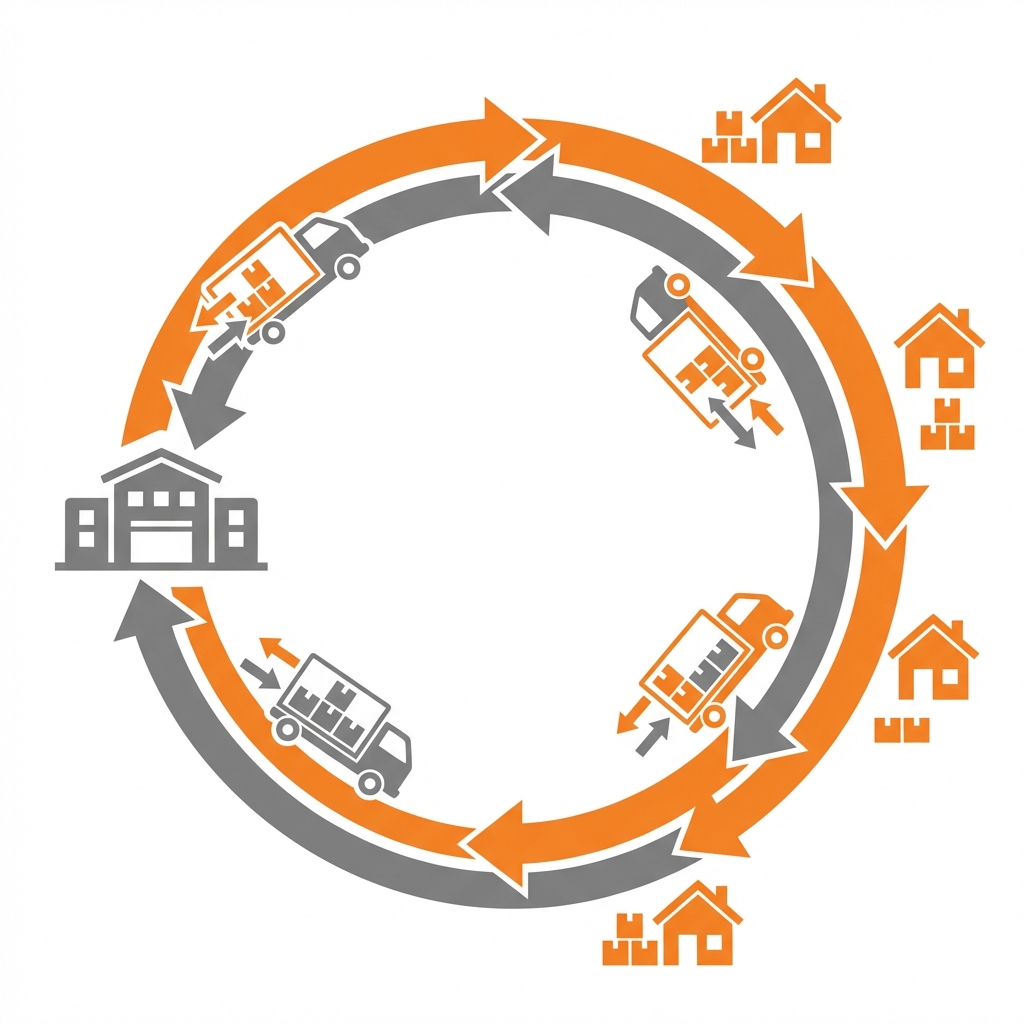
Closing the Loop: From Delivery to Recovery
Reverse Logistics refers to the process of moving goods from their typical final destination for the purpose of capturing value, or proper disposal. In modern supply chains, this isn't just an afterthought—it's a critical operational layer involving returns, recycling, and reusable packaging.
Industries & Use Cases
- E-Commerce Returns:
- Scenario: A driver delivers new packages and simultaneously collects "Return to Sender" items from customers.
- Compliance: Returns must be brought back to the depot, not mixed with the next customer's fresh delivery.
- Beverage & Keg Distribution:
- Scenario: Delivering full kegs of beer to bars and picking up empty ones.
- Constraint: "Empty" kegs still take up space. You cannot pick up 10 empties if you haven't offloaded 10 full ones first.
- Medical Waste Disposal:
- Scenario: Dropping off sterile supplies and collecting biohazard waste.
- Constraint: Strict separation and often different destination processing facilities.
The Optimization Challenge
Reverse logistics introduces "Precedence" and "Capacity Fluctuations" that simple A-to-B routing ignores.
- Capacity Dynamics: Your truck isn't just getting emptier; it's getting emptier of Product A and fuller of waste/return B. You need to track net capacity at every stop.
- Stop Sequencing: You can't pick up a return item if the truck is fully loaded with outbound deliveries. The sequence matters immensely.
Modeling with the API
Our optimization engine supports these workflows natively through PDP (Pickup & Delivery Problem) modeling and multi-trip handling.
1. Mixed Pickup & Delivery (PDP)
The core mechanism for reverse logistics is treating every job not just as a "drop-off" but as a potential "exchange".
- Standard Delivery: Pickup at Depot -> Dropoff at Customer.
- Simple Return: Pickup at Customer -> Dropoff at Depot.
- Exchange: Dropoff Item A (Delivery) AND Pickup Item B (Return) at the same location.
The solver manages the Vehicle Capacity dynamically. If a truck has 100 units of space and delivers 10 units, it immediately gains 10 units of free space that can be used to pick up returns later in the route.
For configuration details, see Logistics API Settings (specifically only_pdp and capacity settings).
2. Multi-Trip & Backhaul
In scenarios where "Backhaul" refers to a distinct long-haul return trip (e.g., driving A to B with goods, then finding a load from B back to A), this is effectively a Multi-Trip planning problem.
- Wave 1: Outbound Distribution.
- Wave 2: Inbound Collection.
For setting up these sequential workflows, refer to the Wave Planning & Multi-Trip Routes guide.
3. Controlling Stop Density
Reverse logistics can explode the number of stops if not managed. You might want to cap the number of "Pickup-only" stops to prevent a driver from becoming a glorified trash collector at the expense of delivery speed.
Use constraints to limit the total workload:
- Trip Stops - Limit the total nodes visited per route.
- Max Trip Duration - Ensure the added complexity doesn't violate shift limits.
By integrating returns into your primary delivery routes, you can reduce total mileage by up to 30% compared to running a separate "collection-only" fleet.