Wave Planning & Multi-Trip Routes
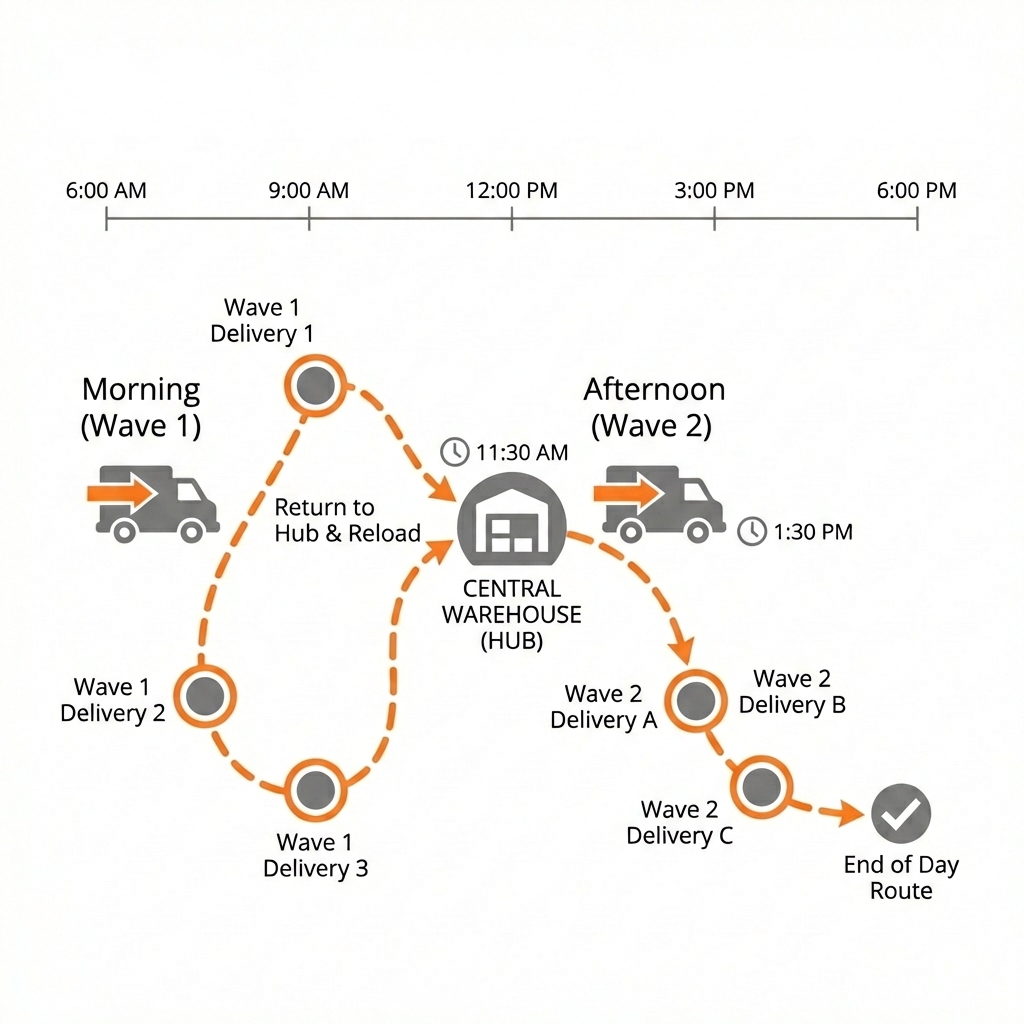
Maximizing Fleet Utilization with Double Runs
Wave Planning (or Multi-Trip routing) represents the operational strategy where a single vehicle performs multiple distinct delivery loops in a single shift. Instead of a truck sitting idle after completing a 4-hour morning run, it returns to the depot, reloads, and executes a second (or third) "wave" of deliveries.
This strategy is critical for increasing asset utilization—getting more value out of every truck and driver on the road.
Industries & Use Cases
- Urban Last-Mile Delivery:
- Scenario: E-commerce or courier vehicles with small capacity but short distances. A van might depart at 08:00, deliver 50 packages, return to the hub at 12:00, reload, and depart again at 13:00.
- Goal: Minimize the fleet size required to cover daily volume.
- Bakery & Fresh Food:
- Scenario: Morning wave delivers fresh bread (must be at stores by 07:00). Second wave collects returns/empties or delivers ambient products with less critical deadlines.
- Goal: Meet strict morning time windows without purchasing a massive fleet that sits idle for the rest of the day.
- Beverage Distribution:
- Scenario: Heavy loads mean trucks hit weight capacity quickly. They "weigh out" before they "time out," requiring a return to the warehouse to restock.
The Optimization Challenge
Manual planning for multi-trip routes is significantly harder than standard routing because of the "interdependencies" between trips:
- Time Synchronization: Trip A must finish and allow reload time before Trip B can start.
- Depot Capacity: You cannot have your entire fleet return to the reload docks at the exact same minute; dock slots are limited.
- Driver Hours: Total shift time must respect legal driving limits, summing up the drive time of all waves plus reload times.
Modeling with the API
Our optimization engine treats multi-trip routing as a first-class citizen, allowing you to define route quality constraints and reload rules explicitly.
1. Enabling Multi-Trip Logic
To allow a vehicle to perform multiple trips, you don't need complex workarounds. You simply need to ensure your constraints allow for it.
Key Concept: Reload Stops A vehicle completes a trip when it visits a location designated as a "Reload" point (usually the depot) or concludes its route. The solver automatically decides if a return to the depot is efficient.
For detailed implementation guidance, refer to the Trip Stops Documentation.
2. Controlling Wave Duration
Often, you want to enforce that no single "wave" is too long (e.g., to keep food frozen), or that the driver takes a break between waves.
- Max Trip Duration: Limits the length of any single loop from depot to depot.
- Max Route Duration: Limits the total shift length (Trip 1 + Reload + Trip 2).
For detailed implementation guidance, refer to the Max Trip Duration Documentation.
3. Balancing Costs & Utilization
You can guide the solver to prefer multi-trip routes over hiring new vehicles by adjusting cost parameters.
- Fixed Cost: High fixed costs for using a vehicle encourage the solver to reuse existing vehicles (Wave 2) rather than activating a new one.
- Trip Cost: You can assign a specific "cost per trip" to penalize excessive reloading if you prefer fewer, longer routes.
For detailed implementation guidance, refer to the Trip Cost Documentation.
By configuring these parameters, you turn a static fleet into a dynamic circulation system, drastically reducing the number of vehicles needed to service high-volume operations.